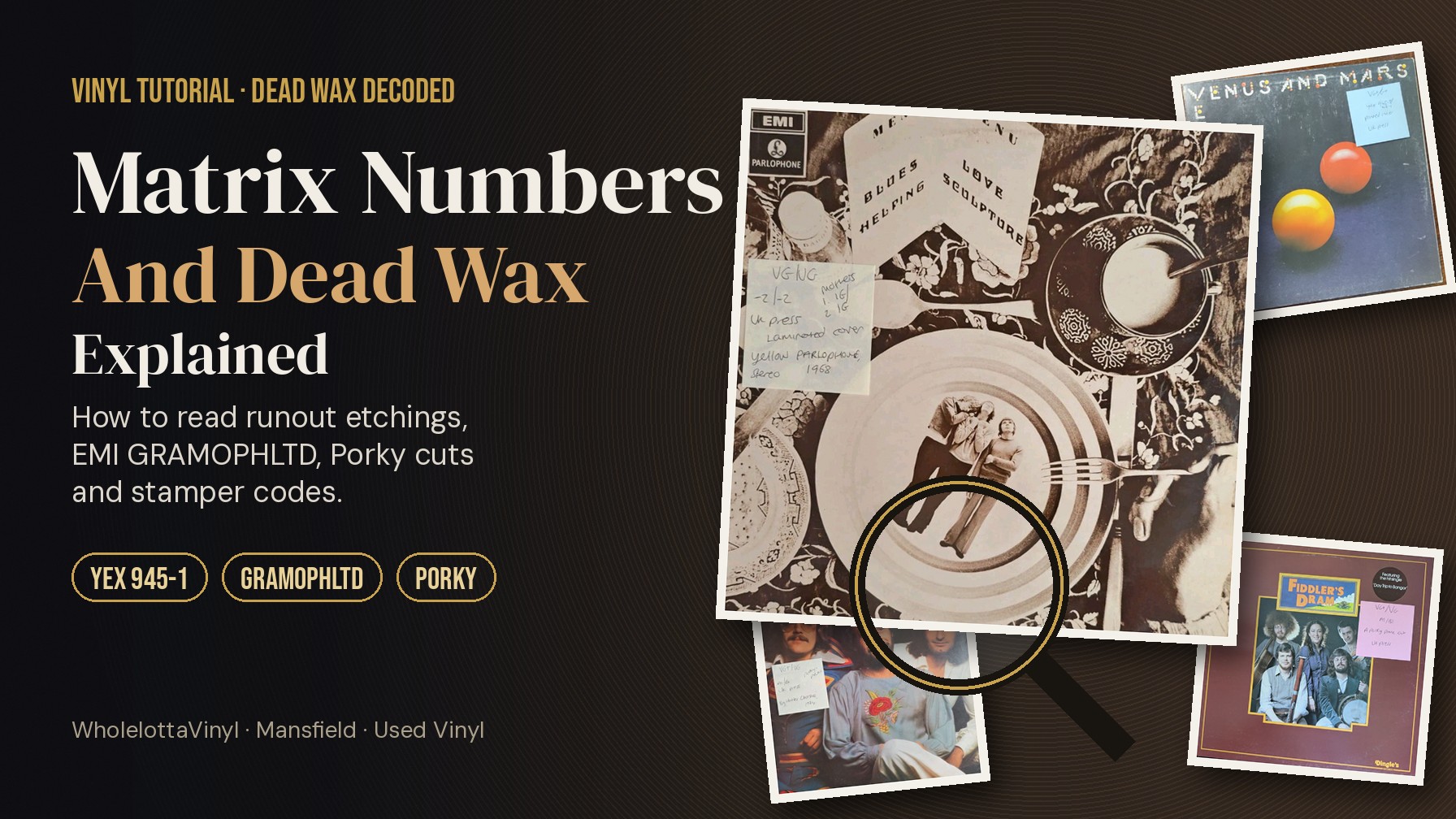
If you've ever tipped a record under a desk lamp and squinted at the shiny ring between the last track and the label, you've stared at the dead wax. That thin strip of silence is where the factory left its homework: the vinyl matrix number, mother marks, stamper codes and the odd joke from a cutting engineer who clearly had too much coffee. This is our Mansfield record shop guide to how to read matrix numbers and runout etchings on used vinyl, with real copies from the crates.
We already covered the EMI 6/9/3 o'clock layout briefly in how to spot a first pressing. This post goes further: lacquer vs mother vs stamper, other plants' systems, Porky and Pecko etchings, Sterling and Masterdisk stamps, and what those codes do (and don't) prove.
What is a vinyl matrix number?
A vinyl matrix number is the alphanumeric code cut or stamped into the runout (the dead wax). It identifies the lacquer for that side of the disc. It is not the catalogue number on the spine, though the two often rhyme.
On a UK EMI stereo LP you might see something like YEX 973-2. The letters and main digits are the matrix; the number after the dash is the cut. Side A and side B get different matrix numbers, usually sequential. The same album on a reissue can keep a related matrix string or get a completely new one, which is why matrix numbers matter when you're matching a copy to a Discogs version.
If you're still sorting original vs reissue language, our guide to original vs reissue vs repress vs remaster sits beside this one nicely.
How do you read matrix numbers in the dead wax?
Hold the record so the label is a clock face. On classic UK EMI pressings (roughly 1962 into the late 1970s) the factory used a tidy layout:
- 6 o'clock: the matrix and cut, e.g. YEX 178-2
- 9 o'clock: the mother number (a plain digit such as 1 or 2)
- 3 o'clock: the stamper code, written in letters
Tip the vinyl in raking light. Stamper letters are often embossed (they stand slightly proud); lacquer and mother marks are usually carved in. A bright phone torch and a patient thumb beat any amount of squinting in a dark loft.
Lacquer, mother, stamper: what the runout is actually describing
Before a record hits the shop floor it goes through a chain of metalwork. The cutting engineer cuts a soft lacquer (sometimes called an acetate) from the master tape – that cut becomes the matrix number, with a dash suffix for which cut it was (-1, -2, -3…). The lacquer is electroplated into a negative father, then (for serious runs) a positive metal mother, then negative stampers that actually go in the press.
Rough factory maths from specialist write-ups: one mother might yield around ten stampers, and one stamper a couple of thousand copies. Big sellers needed re-cuts, so a -2 is not automatically "worse"; it may have been in the first shipment. The honest grade of a used copy is still how it looks and plays – see our vinyl grading explained post.
EMI's GRAMOPHLTD stamper code (and why Beatles collectors mutter it in their sleep)
EMI didn't number stampers with ordinary digits. They used the letters of GRAMOPHLTD:
G=1, R=2, A=3, M=4, O=5, P=6, H=7, L=8, T=9, D=0
So G is stamper 1, GT is 19, GRM is 124, and GG is 11. The code goes back to The Gramophone Company and stayed in use at Hayes for decades – which is why Beatles Parlophone and Apple collectors learn it by heart.
Prefixes help too. On Parlophone, YEX is stereo and XEX is mono. Columbia often used YAX / XAX. A trailing letter after the cut can mean something specific: N (pre-1965 Neumann mono head), G (grouped master from several sources), U (lacquer cut outside Abbey Road, for example at Apple).
Worked example from our crates: Love Sculpture – Blues Helping (Parlophone PCS 7059, 1968), Dave Edmunds's late-60s band. It's the UK stereo on the yellow and black Parlophone label in a laminated flipback sleeve. The listing notes -2 cuts on both sides with mother 1 and a G stamper. A -2 here is not a red flag on its own: the UK stereo copies documented by Discogs contributors carry YEX 701-2 and YEX 702-2. Always match the full string to what's recorded for that release.
How EMI matrices changed after 1980
From late 1980 into 1982 EMI kept the clock-face positions but dropped the GRAMOPHLTD cypher, so the 3 o'clock mark became an ordinary stamper number. From 1982 the 3/6/9 layout itself went, and the runout often appears as one hyphenated string anywhere in the dead wax: matrix-cut-mother-stamper, for example YEX 179-6-1-2.
Worked example: Bob Seger & The Silver Bullet Band – The Distance (Capitol EST 12254, 1982). The matrices read EST 12254-2-1-1 / EST 12254-1-1-1 – cut, mother and stamper packed into one continuous EMI-style string. Handy when an older guide still tells you to look only at 6 and 9 o'clock.
Decca's BUCKINGHAM code (same idea, different crossword)
Decca used the same clock idea but a different word for stampers: BUCKINGHAM (B=1, U=2, C=3, K=4, I=5, N=6, G=7, H=8, A=9, M=0). So B is the first stamper, UI is 25, NN is 66. Decca matrix strings often add an engineer letter after the cut (A for Guy Fletcher, and so on). For early Stones or other New Malden pressings, low mother plus B is what people look for – still beside label design and catalogue details, not instead of them.
Porky, Pecko, Sterling, Masterdisk: signatures in the dead wax
Not every mark is a factory inventory code. Cutting engineers left signatures:
- A Porky Prime Cut, Porky, Pecko, Pecko Duck and assorted jokes point to George "Porky" Peckham, the legendary UK cutting engineer who started at Apple and later ran Porky's Mastering. His etchings are hand-written and often funny.
- STERLING (often with engineer initials such as LH) points to Sterling Sound in New York.
- MASTERDISK (with initials such as RL, HW, GK) points to Masterdisk, the other famous New York room.
A mastering stamp alone rarely pins a release; combine it with the matrix string, catalogue number and label. If Discogs lists STERLING LH and your copy has a hand-etched RL instead, you're holding a different cut.
In the crates right now: Fiddler's Dram (Dingle's DID 711, 1980) carries A Porky Prime Cut in the runout – a textbook Peckham signature on a UK first press. Refugee (Charisma CAS 1087, 1974), the Patrick Moraz / Lee Jackson / Brian Davison trio, shows Porky / Pecko etchings on the Big Hatter Charisma pressing. Both are the sort of dead-wax Easter eggs that make a £5 or £10 copy feel like it winked at you.
Island, Liberty and "A1 / B1" style runouts
Not every plant used EMI's crossword. Many early-70s UK Island and Liberty pressings show simpler marks such as A1 / B1 or A-1U / B-1U. Treat those as useful clues for that release, not a universal law. We covered Free's Highway and the Groundhogs' Split in the first pressing guide – cross-check label and catalogue number before you celebrate.
How to read matrix numbers before you buy (a short checklist)
- Note the full runout on both sides (matrix, cut, mother, stamper, any words or stamps).
- Check the catalogue number on spine, back and labels still match.
- Look the release up on Discogs for your country and compare the runout field line by line.
- Don't crown a copy "first press" on a -1 alone. Labels, tax codes, sleeves and documented variants still matter.
- Play-grade the quiet passages. A glamorous 1/G stamper on a scuffed copy is still a scuffed copy.
We won't make up values for you. Condition and completeness matter more than any "rare stamper" claim in a listing title. VG is a playable grade when it's graded honestly.
Matrix numbers in the WholelottaVinyl crates
In stock as we write: all used vinyl, hand-graded and photographed as the actual copy, at our independent record shop in Mansfield.
The EMI clock-face lesson: Love Sculpture – Blues Helping LP (PCS 7059, 1968), graded VG/VG, £25. Yellow and black Parlophone stereo, laminated flipback, with the -2 / mother 1 / G stamper story above. Bring a torch.
First-cut Wings: Wings – Venus And Mars LP (PCTC 254, 1975), graded VG+/G+, £5. UK press with printed inner; matrices YEX 945-1 / YEX 946-1.
Second-cut Wings: Wings – London Town LP (PAS 10012), graded VG+/VG+, £10. Printed inner and poster; matrices YEX 973-2 / YEX 974-2 – handy for comparing -1 and -2 in one basket.
Later EMI hyphen string: Bob Seger & The Silver Bullet Band – The Distance LP (EST 12254, 1982), graded VG/VG, £7.50. UK Capitol press in the post-1980 continuous matrix format.
A Porky Prime Cut: Fiddler's Dram – Fiddler's Dram LP (DID 711, 1980), graded VG+/VG, £5. UK Dingle's first press with Peckham's signature in the runout.
Pecko on Charisma: Refugee – Refugee LP (CAS 1087, 1974), graded VG+/VG, £10. Big Hatter Charisma UK press with Porky / Pecko etchings.
Parlophone practice: The Hollies – Greatest Vol 2 LP (PCS 7148, 1972), graded VG+/VG+, £5. Matrices 879-1 / 880-1.
A1/B1 Liberty lesson: Groundhogs – Split LP (LBG 83401, 1971), graded VG/VG, £20. Gatefold Liberty black label with A1/B1 style marks.
If you're after a particular early EMI or Decca stamper we haven't got, drop it on our wanted list and we'll keep an eye open.
Buy any three records and 10% comes off the whole crate at checkout, so three £5 LPs come to £13.50. New customers can use Autumn10 for 10% off instead (one code per order). Every record gets a Pro-Ject VC-S3 clean before it's posted (see why choose us), and you can add a Degritter ultrasonic clean for £2; details are on the cleaning service page.
Clearing the loft? We'll take it off your hands
Got a box of second-hand vinyl with mysterious etchings and no Discogs login? We'll buy collections, grade them properly and put the good ones back into circulation. Start at sell vinyl records or contact us. Ladder not included.
Dig the crates
Practise on the copies above, then dig the rest of the shop. You can reserve online and collect in Mansfield if you'd rather decode the dead wax with us looking over your shoulder (kindly, and with a brew). For more buying basics, see where to buy used vinyl records online in the UK. Torch batteries not included – but the matrix numbers usually are.


