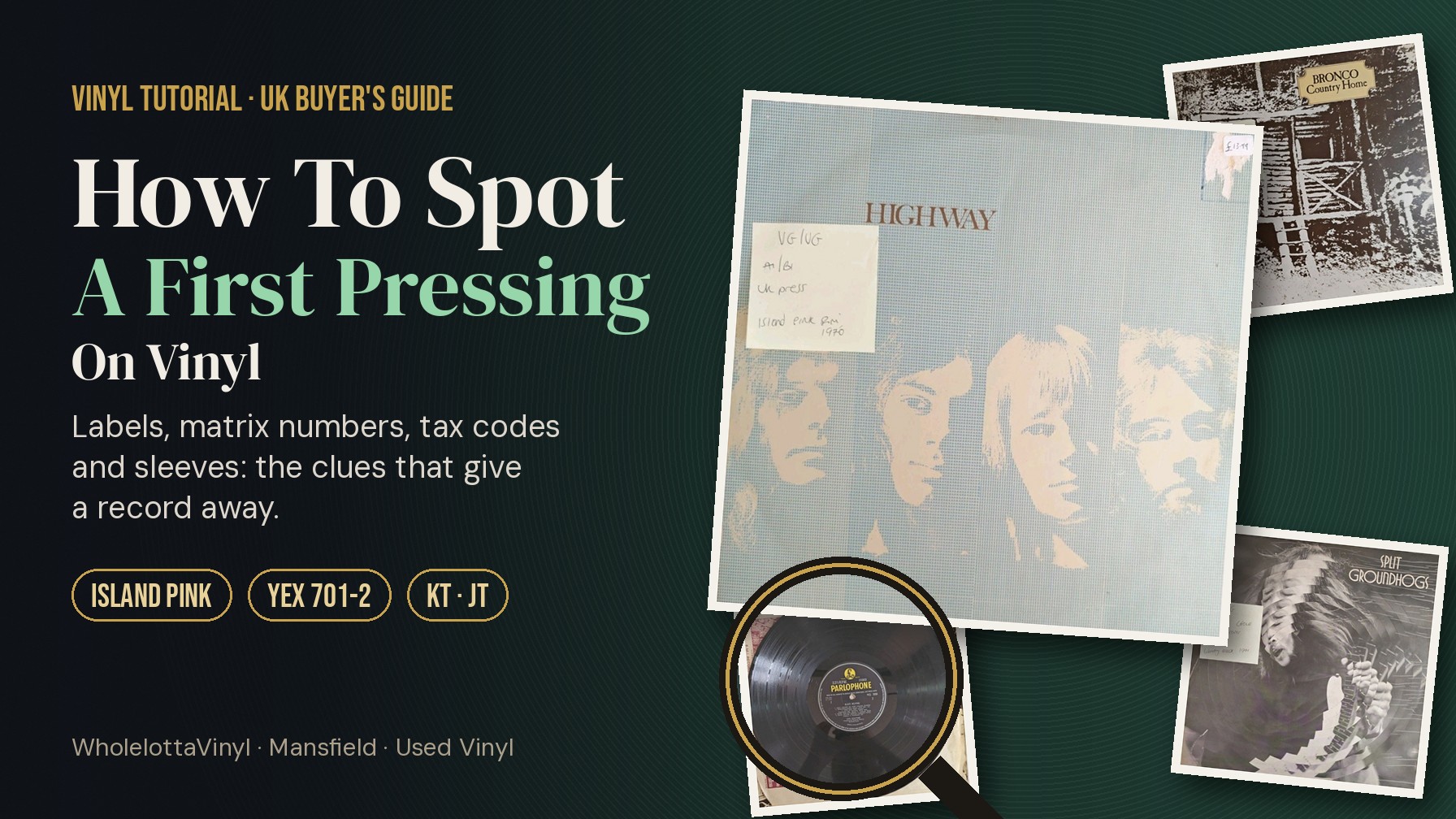
Every week someone taps a sleeve at the counter and says the magic words: "I think it's a first pressing." Sometimes it is. Often it's a lovely 1980s repress with a 1969 date on the back, which proves about as much as the date on your nan's Christmas cake tin. This is our UK buyer's guide to how to tell if a vinyl is a first pressing: the labels, catalogue numbers, run-out codes, tax codes and sleeves that give a record away, using real copies from the crates at our Mansfield record shop.
If you want the bigger picture first, our guide to original vs reissue vs repress vs remaster explains what those words mean. This one is the magnifying-glass bit.
What counts as a first pressing on vinyl?
A first pressing comes from the very first batch made in a particular country: original label, original catalogue number, original lacquers, mothers and stampers. That matters, because a hit album could be pressed for years with the same number and front cover.
So "first press vinyl" really means "matches every detail of the earliest known copies". No single clue proves it. You're building a case, like a very slow episode of Columbo, with more dust.
And "UK first pressing" means the first British copies; a German or American copy from the same year isn't one.
The year on the sleeve isn't the year it was pressed
The ℗ or © date tells you when the recording or artwork was first published, and it often stays the same on every pressing for decades.
Our favourite example in stock is The Beach Boys – Little Deuce Coupe. The album first came out in America on 7 October 1963, and that date crops up all over the internet. Our copy is the UK mono issue on Capitol, catalogue number T 1998, on the black label with the rainbow rim, and the UK release didn't follow until 1965. Same hot rod, two years and an ocean later.
How do I know if my vinyl is a first pressing? Start with the label
Labels redesigned their artwork every few years, and collectors have mapped the changes closely. If your copy's label design came in after the album was released, it's a later pressing.
Island Records is the textbook case for UK collectors:
- The first pink label, with a lower-case "island" along the bottom and an orange and black "eye" logo, ran from late 1967 to mid-1969.
- The "black block" label, with a big black "i", was a short-lived design from around September 1969.
- The pink label with a large white "i", and "Island Records Stereo" around the edge, ran from late 1969 and through most of 1970.
- The "pink rim" or "palm tree" label, white with a pink edge and a palm tree, arrived in late 1970 and lasted about five years.
So an album released in mid-1970 should first appear on the white "i" label; a palm tree copy is later. Our copy of Bronco – Country Home (ILPS 9124, 1970) is on the pink label with the white "i", in its gatefold sleeve, which is how the first UK copies were issued. Discogs even notes a lovely quirk: the tracks are printed in the wrong order on the back cover, and the label has them right. The sleeve printer clearly had a long week.
Now flip it round. Free – Highway (ILPS 9138) came out in December 1970, just after the palm tree label arrived, so for this one the pink rim label is the first pressing. Discogs lists the first UK copies with "Side 1", "Side 2", "ILPS-9138", "℗ 1970" and "STEREO" on the labels, a matte sleeve with an embossed picture of the band on the back, and a pale blue polylined Island inner sleeve with the Basing Street, London W11 address.
Catalogue numbers and the small print
Check that the catalogue number matches on the spine, the back of the sleeve and both labels. A different prefix or a new number usually means a reissue, and a budget label (Fame, MFP, Hallmark, Pickwick) means it definitely isn't the first issue.
Then read the small print on the label, which changed more often than the design did:
- Mono or stereo prefixes. On UK Parlophone, PMC was mono and PCS was stereo. On Capitol, T was mono and ST was stereo. In the 1960s both were often released at once, so a first pressing can exist in each.
- "Sold in U.K. subject to resale price conditions". This line appeared on EMI labels from February 1964 and was generally dropped around 1969, although leftover label stock sometimes carried it later.
- Company addresses. When a label moved office, the wording on labels and inners changed, which is why that Basing Street address on the Free inner is useful.
UK purchase tax codes: the clue most people miss
Look closely near the centre hole of an older UK record and you might find two embossed letters, such as KT or JT. These purchase tax codes mark the tax rate in force when the record was made.
- KT was introduced on 1 July 1963.
- JT was introduced on 23 November 1968.
- Purchase tax was replaced by VAT on 1 April 1973, so the codes stop there.
So a 1963 album with a JT code was pressed in November 1968 or later. Not a first pressing, but no less of a record. As one jazz collector's guide to tax codes puts it: follow the money.
Matrix numbers: what the dead wax tells you
The run-out area (the dead wax between the last track and the label) carries the most precise clues of all. On 1960s and 1970s EMI pressings there are usually three:
- At 6 o'clock, the matrix number. For example YEX 701-2. The number after the dash is the lacquer cut, so -1 was the first cut, -2 the second and so on.
- At 9 o'clock, the mother number. A 1 means the first mother made from that lacquer.
- At 3 o'clock, the stamper code. EMI spelt numbers with the letters of GRAMOPHLTD: G=1, R=2, A=3, M=4, O=5, P=6, H=7, L=8, T=9, D=0. So G is the first stamper, and GT would be the 19th.
Our copy of Love Sculpture – Blues Helping (Parlophone PCS 7059, 1968), Dave Edmunds's late-60s band, is a great one to learn on. It's the UK stereo on the yellow and black Parlophone label in a laminated flipback sleeve, and the listing notes -2 cuts on both sides along with a mother 1 and a G stamper. A -2 doesn't automatically mean a later pressing: the UK copies documented by Discogs contributors and specialist dealers carry YEX 701-2 and YEX 702-2 (a -1 turns up on the German Odeon pressing). That's why you check matrix numbers against what's documented for that release, rather than assuming -1 or nothing.
Other companies had their own systems. Some early-70s UK pressings add a letter after the cut number, such as A-1U and B-1U, and specialist sources list those as the earliest run-outs on first UK copies of both Free's Highway and the Groundhogs' Split. Our deeper guide to reading run-outs is coming soon.
Sleeves and inners: the supporting evidence
Sleeves changed too. Look for:
- Flipback sleeves, with folded-over flaps glued on the back, common on 1960s UK LPs.
- Laminated or matte finishes, and printer credits such as Garrod & Lofthouse or E.J. Day.
- Embossing that later runs dropped, like the band picture on the back of the first Highway sleeves.
- Company inner sleeves from the right era, though these swap between records easily, so treat them as a clue, not proof.
Inserts and posters that only came with early copies help too. Nobody threw away a poster like a teenager in 1972.
Check Discogs, then check the condition
Once you've noted the label, catalogue number, small print, tax code and run-outs, look the album up on Discogs and go through the versions for your country. The release notes and collectors' comments are where most first-pressing details live. Match every point, not just one.
Then look at the condition, because that matters more than any label. Our vinyl grading guide explains VG, VG+ and EX, and our guide to spotting a good second-hand record covers the rest.
We won't make up values for you. A battered first pressing can be a worse buy than a clean later copy, and condition and completeness matter more than any "rare" variation in a listing title. VG is a playable grade when it's graded honestly, and that's how we grade.
Early UK pressings in the WholelottaVinyl crates
In stock as we write: all used vinyl, hand-graded and photographed as the actual copy, at our independent record shop in Mansfield.
The palm tree first: Free – Highway LP (ILPS 9138, 1970), graded VG/VG, £30. A UK copy on the pink rim Island label, the label Highway was first issued on. The Stealer, The Highway Song and Be My Friend, from the band that had just given the world All Right Now. Air guitar strongly advised.
The white "i": Bronco – Country Home LP (ILPS 9124, 1970), graded VG+/VG, £25. The pink Island label with the white "i", in the gatefold sleeve, with Jess Roden's band doing country rock in a very British way. Check the back cover for that wrong-order tracklist.
The dead-wax lesson: Love Sculpture – Blues Helping LP (PCS 7059, 1968), graded VG/VG, £25. UK stereo on yellow and black Parlophone with a laminated cover, recorded at Abbey Road in the summer of 1968. Bring a torch and a magnifying glass. Deerstalker optional.
The laminated gatefold: Groundhogs – Split LP (LBG 83401, 1971), graded VG/VG, £20. A UK copy on the black Liberty label in the laminated gatefold, matching the first UK issue. Cherry Red is on side two, and it's loud enough to rattle the biscuit tin.
The date trap: The Beach Boys – Little Deuce Coupe LP (T 1998, UK mono), graded VG/G+, £15. The UK mono on the Capitol rainbow rim label, a lesson in why the American release date isn't the date of a British copy. The sleeve has done some miles, much like the cars.
Buy any three records and 10% comes off the whole crate at checkout, so three £5 LPs come to £13.50. New customers can use Autumn10 for 10% off instead (one code per order). Every record gets a Pro-Ject VC-S3 clean before it's posted (see why choose us), and you can add a Degritter ultrasonic clean for £2; details are on the cleaning service page.
Clearing the loft? We'll take it off your hands
Got a box of records and a hunch there's a first pressing in there? We check every label, run-out and sleeve properly, and we buy collections big and small. Start at our sell your records page or get in touch. Ladder not included.
Dig the crates
Browse the whole shop for more used vinyl and second-hand vinyl from the 1960s and 1970s. Hunting a particular first pressing we haven't got, like a mono PMC 7059 Blues Helping or a first pink label Island album? Add it to our wanted list, and you can reserve online and collect from our Mansfield record shop. We'll even lend you the magnifying glass.