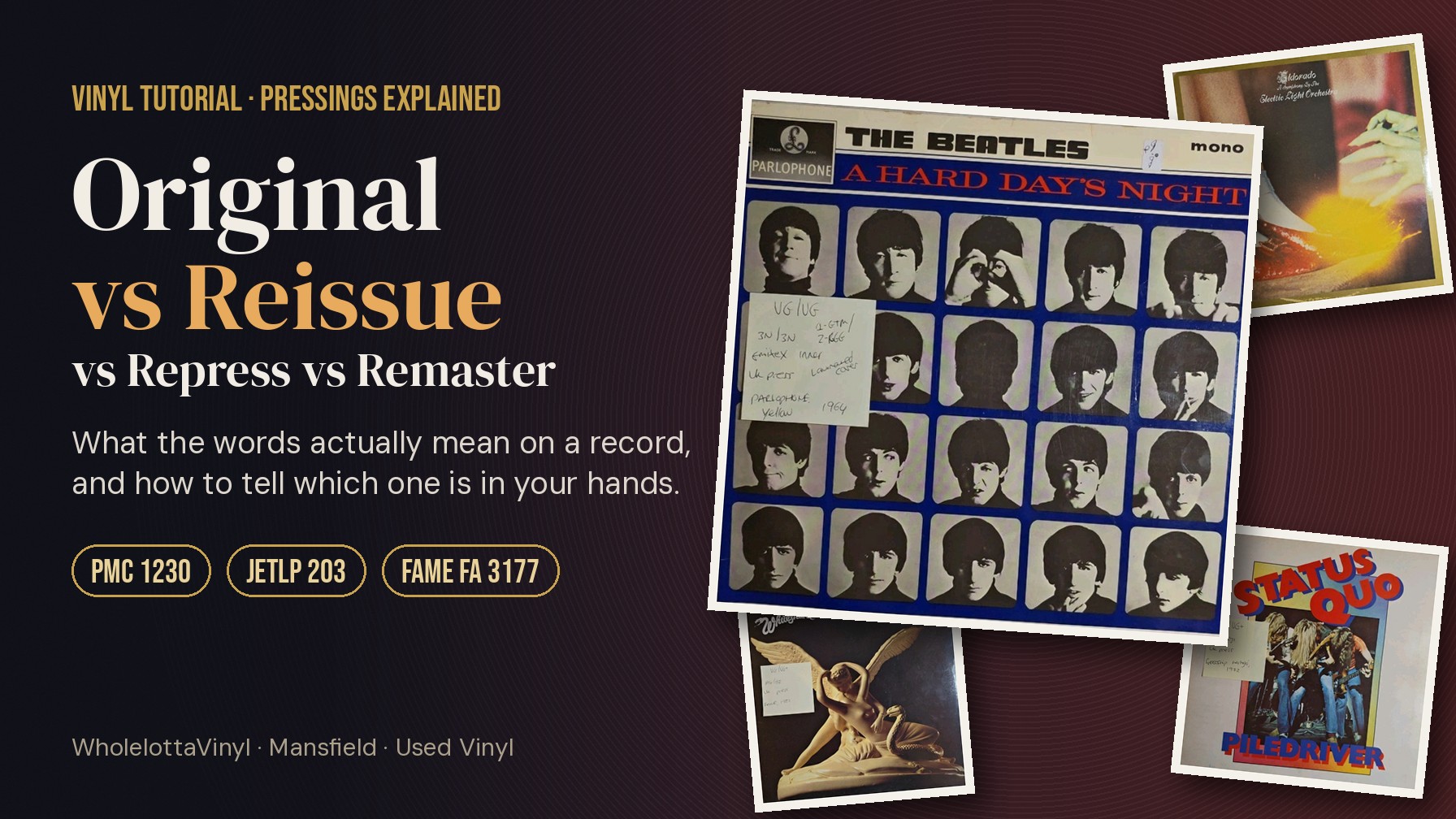
Somewhere right now, someone is staring at two copies of the same album, one at £5 and one at £50, wondering if the shop has lost its marbles. Usually it hasn't. The difference is in four little words that get thrown around record fairs like confetti: original, reissue, repress and remaster. This is our plain-English guide to original vs reissue vinyl, what a repress actually is, what "remastered vinyl" means, and how to tell which one you're holding, using real records from the crates at our Mansfield record shop.
Original vs reissue vinyl: the short answer
The cheat sheet:
- Original (or first pressing): the record as it first came out, on the original label, with the original catalogue number, pressed when the album was new.
- Repress: more copies of the same release, pressed later. Same catalogue number, usually the same music and artwork, often from the same master. The label design, sleeve printer or inner sleeve may change as the years go by.
- Reissue: the album put out again as a new release, often on a different label, with a new catalogue number, sometimes with new artwork or tracks.
- Remaster: the audio itself has been mastered again, usually from the original tapes or a digital transfer, so it can sound different. A remastered LP is a new pressing by definition, but a new pressing isn't necessarily remastered.
Think of it like Woolies pick 'n' mix: the same sweets in a new bag (repress), the same sweets in a different shop's bag (reissue), and the same sweets with a new recipe (remaster). Nobody asked for the recipe change, but here we are.
What is a first pressing (and why do people care)?
A first pressing is the earliest batch of a record to leave the factory. Collectors like them because they're the original label, the original sleeve and, often, the original cut of the audio. Whether that sounds better is an argument we'll leave to the forums.
Our best example in stock is The Beatles – A Hard Day's Night (PMC 1230). The UK album came out on 10 July 1964 in mono, catalogue number PMC 1230, on the black and yellow Parlophone label. Beatles collectors pin the first pressing down with details like the label wording ("Recording First Published 1964" and the "Sold in U.K. subject to resale price conditions" line), the stamped matrix numbers in the run-out (XEX 481-3N and XEX 482-3N) and the laminated flipback sleeve, printed by either Garrod & Lofthouse or Ernest J. Day.
The lesson: a first pressing isn't proved by the year on the sleeve. It's proved by the small print on the label, sleeve and dead wax, checked against a good discography. Our full "how to spot a first pressing" guide follows on Saturday 10 October.
What is a repress? (Same number, different decade)
A repress can look almost identical to the original: same album, same catalogue number, same front cover. The giveaway is usually something boring that changed at the factory.
The perfect example is Status Quo – Piledriver (6360 082). Released in the UK on Vertigo on 15 December 1972, the first copies came in a gatefold sleeve with the famous Vertigo "swirl" label. Vertigo dropped the swirl in early 1973 and switched to the green "Spaceship" label, and Piledriver kept selling, so later copies were pressed with the same catalogue number on the new label. Discogs even notes a tiny tell: the earliest copies spell the second track "O Baby" on both the label and the back cover, while later ones say "Oh Baby" on the label.
So a Spaceship-label Piledriver is a repress: the same record, same number, pressed later. It still plays Paper Plane just as loud. Your neighbours won't know the difference. Your mate from the pub will, and he'll tell you, at length.
Repress vs reissue: what's the actual difference?
The clean version of repress vs reissue: a repress keeps the original catalogue number because it's the same release, pressed again. A reissue is a new release of an old album, normally with a new catalogue number, often a new label, and sometimes new artwork, tracks or mastering.
Our ELO copy shows it beautifully. Eldorado first came out in the UK in 1974 on Warner Bros, catalogue number K 56090, on the Warner "trees" label with a lyric inner sleeve. In May 1978 Jet Records moved its distribution to CBS and re-issued the ELO back catalogue, and Eldorado came back as JETLP 203 on the Jet label. That's a reissue: new label, new catalogue number, same album.
The twist: Jet and CBS then pressed further batches of JETLP 203, with small label changes along the way (yellow and white light beams, later yellow and pink). So a reissue can have its own represses. Turtles all the way down, but with better strings.
Budget reissues: the Fame, MFP and Hallmark bins
The other big family of reissues in a British record shop is the budget label. EMI's Fame label, Music For Pleasure (MFP), Hallmark and Pickwick put older albums back out at a lower price, usually with a new catalogue number in the label's own series. Plenty of people's first copy of a classic came out of one of those bins.
Two good examples in the crates:
- Whitesnake – Saints & Sinners was first released by Liberty in 1982 as LBG 30354. Our copy is FA 3177 on Fame, a later reissue.
- Sammy Hagar – Nine On A Ten Scale, his first solo album, originally came out on Capitol in May 1976. Our copy is the UK Fame reissue, FA 3068.
A budget reissue isn't a lesser record to play, and the songs don't know what label they're on.
What does remastered vinyl mean?
Mastering is the last step before a record is cut: an engineer takes the finished mix and sets the EQ, levels and dynamics for the format. Remastered vinyl means someone has gone back and done that job again, usually from the original tapes or a high-resolution transfer. It can sound brighter, warmer, louder or quieter than the original: not automatically better, just different.
To spot one, look for "remastered" on the sleeve, sticker or label (often with a year and an engineer's name), a new catalogue number and new matrix numbers in the run-out.
Want the sound of the original cut? Look for an original or an early repress. Want the newest take? Go for the remaster. Want peace in the house? Buy both and don't mention the price.
How to tell if your vinyl is an original or a reissue
The quick checklist we use at the counter:
- Catalogue number. Check that the spine, the back of the sleeve and both labels match. A different number on the label usually means a reissue.
- Label design. Labels changed over time (Vertigo swirl to Spaceship, for one). A later design on an early catalogue number usually means a repress.
- The small print. Copyright, "Made in" and distributor lines, and sleeve printer credits.
- Run-out matrix numbers. Look in the dead wax. Matrix numbers and stamper codes are how collectors date pressings precisely.
- Inserts and inners. Some only came with early copies.
- Check Discogs. Match what you see against the release pages and the notes left by other collectors.
Then check the condition, because that matters more than the label. Our vinyl grading guide explains VG, VG+ and EX, and our guide to spotting a good second-hand record covers the rest.
We won't make up values for you. A first pressing in rough condition can be a worse buy than a clean repress, and condition and completeness matter more than any "rare" variation in a listing title. VG is a playable grade when it's graded honestly, and that's how we grade.
Originals, represses and reissues in the WholelottaVinyl crates
In stock as we write: all used vinyl, hand-graded and photographed as the actual copy, at our independent record shop in Mansfield.
The 1960s original-era mono: The Beatles – A Hard Day's Night LP (PMC 1230, 1964), graded VG/VG, £25. A UK mono copy on the yellow and black Parlophone label, with an Emitex inner sleeve. The best way to learn the first-pressing checks is with one of these in your hands. Fab haircuts included.
The repress: Status Quo – Piledriver LP (6360 082, 1972), graded VG/VG+, £10. A UK copy on the green Vertigo Spaceship label, so a later pressing of the 1972 album. Same boogie, newer spaceship. Denim not included.
The reissue: ELO – Eldorado LP (JETLP 203), graded VG/G+, £12. The Jet reissue of the 1974 Warner Bros original, with the ruby slippers sleeve. Can't Get It Out Of My Head is on side one, and once it's on, neither can you. More ELO in our A New World Record post.
The budget reissue (part one): Whitesnake – Saints & Sinners LP (FA 3177), graded VG/VG+, £12. The Fame reissue of the 1982 Liberty album, with the marble angel sleeve. Big riffs, bigger hair.
The budget reissue (part two): Sammy Hagar – Nine On A Ten Scale LP (FA 3068), graded VG+/G+, £5. The UK Fame reissue of Sammy's 1976 debut solo album on Capitol, VG+ on the record. A fiver for a ten on a ten scale, by our maths.
Buy any three records and 10% comes off the whole crate at checkout, so three £5 LPs come to £13.50. New customers can use Autumn10 for 10% off instead (one code per order). Every record gets a Pro-Ject VC-S3 clean before it's posted (see why choose us), and you can add a Degritter ultrasonic clean for £2; details are on the cleaning service page.
Clearing the loft? We'll take it off your hands
Got a box of records and no idea which are originals? That's exactly what we sort out. We buy collections, big and small, and check every pressing properly. Start at our sell your records page or get in touch. Ladder not included.
Dig the crates
Browse the Status Quo, Beatles and ELO crates, or the whole shop. Hunting a particular original we haven't got, like a Warner Bros K 56090 Eldorado or a swirl-label Piledriver? Add it to our wanted list. You can also reserve online and collect from our Mansfield record shop, where every copy is the original copy of itself, at least.