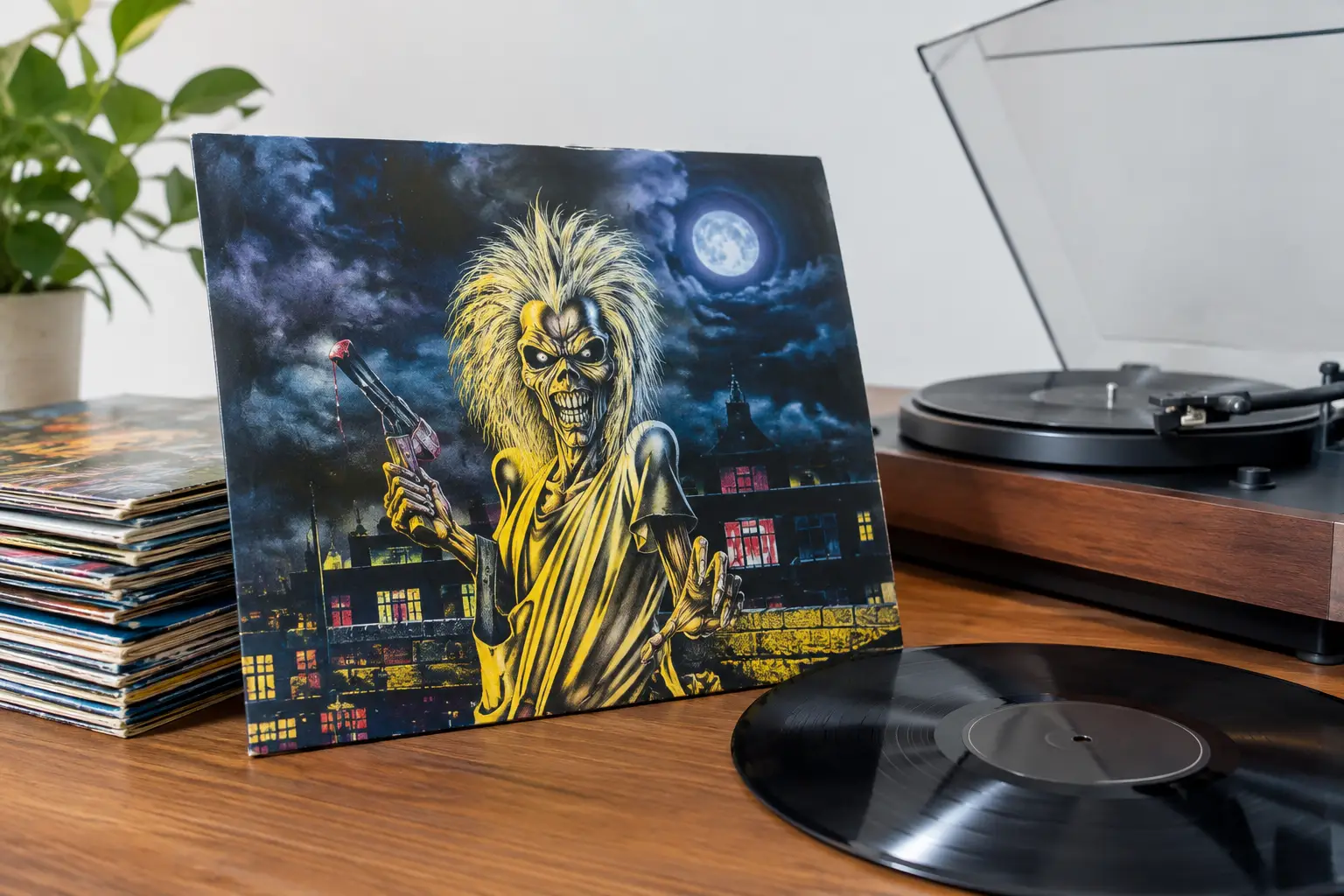
A copy of The Number of the Beast can look like the centrepiece of an Iron Maiden collection from across the room. The difference between a satisfying keeper and an expensive disappointment is often hiding in the dead wax, the spine print or a few seconds of playback. For Iron Maiden vinyl collectors, the album title is only the start of the story.
Maiden's catalogue rewards close attention because it sits at the meeting point of huge popularity, changing formats and fiercely loyal fans. Plenty of copies were played hard at parties, carried around in sleeves that did little to protect them, or stored for decades with posters, inner bags and inserts missing. A careful buyer does not need every record to be flawless, but they do need to know exactly what they are buying.
Why Iron Maiden pressings need a closer look
The core studio albums from the 1980s are the natural hunting ground: Iron Maiden, Killers, The Number of the Beast, Piece of Mind, Powerslave, Somewhere in Time and Seventh Son of a Seventh Son. Original UK EMI issues are often the editions collectors seek first, especially when they retain the correct sleeve, inner and any original extras. Their appeal is part musical history, part artwork and part connection to the band's rise.
That does not mean an earlier pressing is automatically the right one for every collection. A clean later issue may offer better listening value than a tired original with groove wear. Likewise, an overseas pressing can be a sensible choice if it is complete, well cared for and priced accordingly. The useful question is not simply, “Is it rare?” but “What is this exact copy, and does its condition justify its place in my collection?”
Catalogue numbers help establish a starting point. UK examples such as EMC 3330 for Iron Maiden, EMC 3357 for Killers, EMC 3400 for The Number of the Beast, EMA 800 for Piece of Mind and POWER 1 for Powerslave are familiar reference points. But a catalogue number alone does not prove every detail. Labels, sleeve credits, barcodes, country of manufacture and matrix markings all deserve a look.
What Iron Maiden vinyl collectors should inspect
Start with the record, not the hype
A seller description should separate vinyl condition from sleeve condition. A sleeve can be presentable while the record has been overplayed, and a record can play beautifully despite age-related shelf wear to the cover. That distinction matters particularly with Maiden records, where the music often moves from quiet passages into hard-hitting vocals and guitars. Surface marks that appear minor under a light can still be audible between tracks or during softer introductions.
Visual grading is valuable, but playtesting adds another layer of confidence. Listen for repeated clicks, distortion on loud peaks, groove wear, skips and excessive background noise. A properly cleaned record can reveal its true condition more fairly, but cleaning cannot reverse damage already pressed into the groove.
Ask whether the grading reflects an actual inspection under strong light and, ideally, playback. Terms such as “excellent” or “very good” mean more when the seller explains what is behind them: faint sleeve scuffs, a light hairline, occasional low-level crackle, edge wear or a split to the inner sleeve.
Check the dead wax and label details
The run-out area can tell a collector far more than the front cover. Matrix and stamp information may distinguish a first cutting from a later one, identify a plant variation or confirm that the disc belongs with the sleeve. These details are especially worthwhile when a listing claims an early UK issue, a particular pressing or an unusual variant.
There is a sensible limit to matrix chasing. Small differences do not always make one copy dramatically scarcer or better sounding. If you are buying primarily to play the record, a strong-playing copy with honest grading may matter more than a tiny variation in the etching. If you are building a pressing-focused set, then clear photographs and accurate matrix transcription become essential.
Labels should also match the stated edition. Look at the EMI design, perimeter text, publishing credits and side designations. A mismatched disc and cover is not always a problem - collections get mixed over time - but it should be disclosed and reflected in the price.
Treat sleeves, inners and inserts as part of the record
Iron Maiden artwork is not an afterthought. Derek Riggs covers are a major part of why these albums remain so collectable, so ring wear, creasing, seam splits, writing and sticker residue all affect value. The spine is easy to overlook, yet it is often where title, catalogue number and printing details can be checked quickly.
Original printed inners, lyric bags, posters and booklets can make a meaningful difference. Live After Death, for example, is a release where completeness matters to many buyers. The same applies to 12-inch singles, which may have posters, inserts or distinctive picture sleeves. Missing extras do not make an album unplayable, but they do change how it should be described and valued.
Picture discs deserve their own judgement. Maiden picture discs are visually striking and popular display pieces, but many collectors accept that their playback can be less quiet or consistent than a conventional black vinyl pressing. Buy them for the art and the edition itself; do not assume they are the best choice for a critical listening copy.
Building a collection with purpose
There are several satisfying ways to collect Maiden, and choosing one prevents the search becoming an expensive pile of duplicates. Some record addicts focus on original UK studio albums. Others collect every 12-inch single from a favourite era, chase Eddie artwork variations, or look for international issues with alternate sleeves and labels.
A listening-led collection might begin with clean, complete copies of the essential albums, then expand into live sets and singles once the foundations are in place. A variant-led collection may require more patience, closer comparison and a willingness to leave a tempting record behind if the details do not line up.
Condition should shape your buying strategy. A VG sleeve and a strong-playing VG+ record can be an excellent choice if you want the music and the price is fair. For a display copy of Powerslave or Somewhere in Time, sleeve condition may carry greater weight. For scarce singles or early pressings, provenance and correctness can matter as much as the grade itself.
Questions worth asking before you buy
Good listings answer most collector questions before the checkout stage. You should be able to establish the country, catalogue number, format, vinyl grade, sleeve grade and whether the record has been cleaned and playtested. Photographs should show the actual item, not a stock image, with enough clarity to inspect labels, sleeve corners, spines and any notable flaws.
If something is unclear, ask directly whether an insert is included, whether the inner is original, what is written in the run-outs, or whether a mark is audible. These are normal collector questions, not awkward ones. A careful seller should welcome them because accuracy protects both sides of the transaction.
Packaging matters too. Records should be removed from the outer sleeve for posting when appropriate, placed in a protective inner, supported with stiffeners and packed to avoid corner crush. A beautifully graded copy can lose much of its appeal if it arrives with a split seam caused by poor packing.
At WholeLottaVinyl, that collector-first approach means looking beyond an attractive cover: records are cleaned, visually graded, playtested and photographed so the condition story is there to see.
The best Iron Maiden collection is not necessarily the biggest or the most expensive. It is the one where every copy earns its shelf space, whether it is there for the first crack of “Aces High”, the artwork, the pressing detail or simply the memory it brings back when the needle drops.