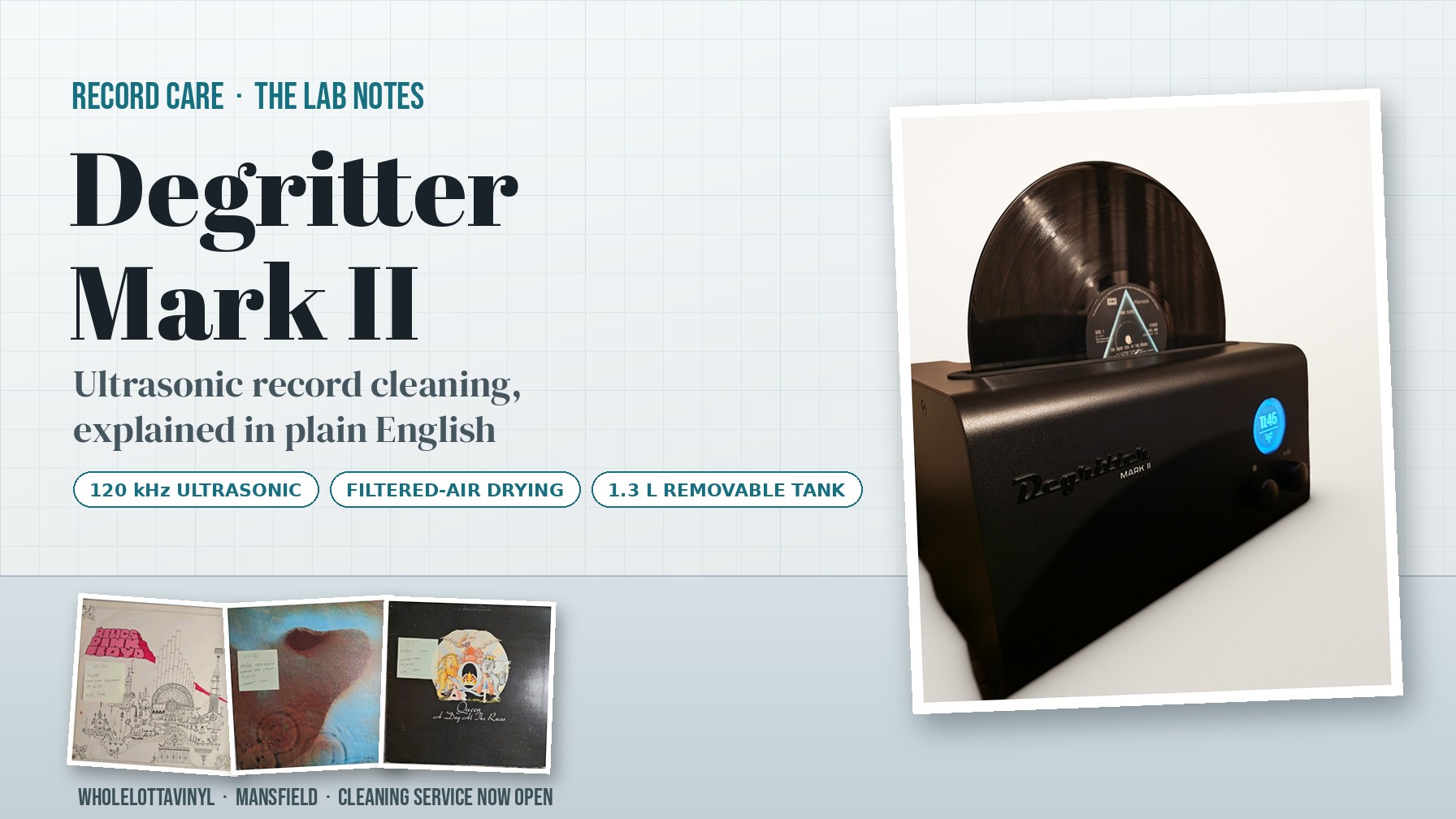
Every box of records that's just landed on our bench has a past. Some have lived a quiet life in a proper sleeve on a proper shelf. Others have spent thirty years in a loft next to the Christmas decorations, collecting dust, fingerprints and the odd mystery smudge. Which brings us to the Degritter Mark II, an ultrasonic record cleaning machine from Estonia, and a rather tidy video that shows exactly what it does.
What is the Degritter Mark II?
The Mark II is a fully automatic record cleaner. You drop a record into the slot on top, pick a programme, press play and walk away. Degritter's own line is that you can spend the time listening to records instead of cleaning them, which is hard to argue with.
Instead of brushes and elbow grease, it cleans with ultrasound. The tank is purpose-built for vinyl, with two ultrasonic transducers on each side (four in total) working at 120 kHz. The frequency sweeps between 120 and 125 kHz to spread the cleaning energy evenly, and a Pulse Mode switches the transducers rapidly on and off at high power for stronger cleaning without driving up average power use. Degritter calls the whole set-up Power Drive 2.0.
How ultrasonic cleaning works, in plain English
Picture the water in the tank being shaken very fast by sound waves. Every pressure wave creates huge numbers of microscopic bubbles, which form and then collapse. This is called cavitation, and each collapsing bubble fires a tiny jet of water at the record. Together, those jets loosen dirt from the surface and from inside the groove.
The clever bit is scale. Degritter's manual explains that the details in a record groove are only a few micrometres in size, too small for a typical record brush to clean the whole groove. The bubbles get where bristles can't, and Degritter says the process removes dirt layer by layer, both on top of the groove and inside it.
A few other things happen while the record turns:
-
Active filtering: the cleaning water is pumped through a replaceable filter during the wash, so dirt that comes off the record doesn't end up back on it.
-
Temperature control: ultrasound slowly warms the water. The Mark II keeps an eye on it and, if the water reaches 35 °C, adds a three-minute cooling cycle to protect the vinyl.
-
Smart drying: records are dried with filtered air. You can adjust both drying time and fan speed, to keep the noise down and to avoid static build-up.
Programmes run from one to four record revolutions. According to the manual, that works out at 2 minutes 15 seconds for one revolution up to 6 minutes 45 seconds for four, before any pre-soak or rinse time. There's also a separate Dry programme and a Degas programme for fresh tanks of water.
What the official video shows

Degritter's own video, Degritter Mark II: Ultrasonic Record Cleaning Made Simple, is short and to the point: under a minute and a half. It introduces the Mark II as fully automatic, cleaning records ultrasonically with distilled water from a removable tank. Degritter's phrase for it is "convenient and mess-free".
It then walks round the machine. The water is filtered and the filters are easy to get at. On the back you'll find an SD card slot for software updates, an AC voltage switch and a physical on/off switch. Vents on the side filter the air used for drying.
Cleaning a disc, as the video shows, is three steps: insert the record, select the cleaning programme (adjusting the drying time if you like) and press play. It's roughly the same effort as putting the kettle on, and considerably less than the old sink-and-tea-towel method.
Finally, it tours the menu. You can add a pre-soak for dirtier discs, rinse records with water from a second tank, reset the filter reminder, adjust the drying fan, make small changes to the water level and check general machine information.
If you want the longer version, Degritter's step-by-step user guide video goes further. It recommends the medium water level for 12-inch records and the high setting for 7-inches, and suggests changing the water every one to two weeks or after about 30 dirty records. It suggests adding 1 to 2 ml of cleaning fluid for a deeper clean, but leaving the fluid out entirely for shellac records. It also covers changing the filter every 50 washing cycles.
Why cleaning matters for sound and condition
Dirt in the groove is noise waiting to happen. Dust and dried-on grime can add crackle and pops that have nothing to do with the record's actual condition, and a stylus ploughing through muck does nobody any favours.
That's why cleaning and grading go hand in hand. As we explain in our guide to what VG, VG+ and EX actually mean, a grade describes how a record looks and how it should sound. A dirty copy can look and play worse than it really is, and you can't judge surface noise fairly through a layer of loft dust. A clean surface gives an honest picture.
What cleaning can't do is undo damage. A scratch is still a scratch after its bath, and a worn groove is still worn. Degritter's manual is refreshingly honest on a related point, too: records caked in a thick layer of gunk can take a while to come clean, and it suggests a wipe with a microfibre cloth first to speed things up. Our own rule with stock is simple, as we explain in how we grade every record by hand: cleaning is never a way to hide damage.
Who is a machine like this for?
Going by what Degritter shows and says, the Mark II suits:
-
Crate diggers with a growing pile of finds. Car boots, charity shops and inherited boxes all come with history attached. Automatic programmes mean you can clean while you sort.
-
Listeners who value their time. Load, press, walk away. According to the tutorial, three beeps tell you the programme has finished, which is your cue to come back.
-
Collectors with a mixed shelf. The water level settings cover 12-inch and 7-inch records (Degritter sells 7-inch and 10-inch adapters as accessories), and Degritter's advice for shellac is pure water with no fluid.
-
Anyone who hates mess. Water lives in a removable tank rather than sloshing about on your kitchen table.
Not everyone wants a dedicated cleaning machine on the sideboard, though. The good news is that you don't need one.
Now open: record cleaning at WholelottaVinyl
We now clean records with a Degritter Mark II, the same model you see in the video. The service is for UK customers: drop your records off in Mansfield by appointment, or post them in from a UK address.
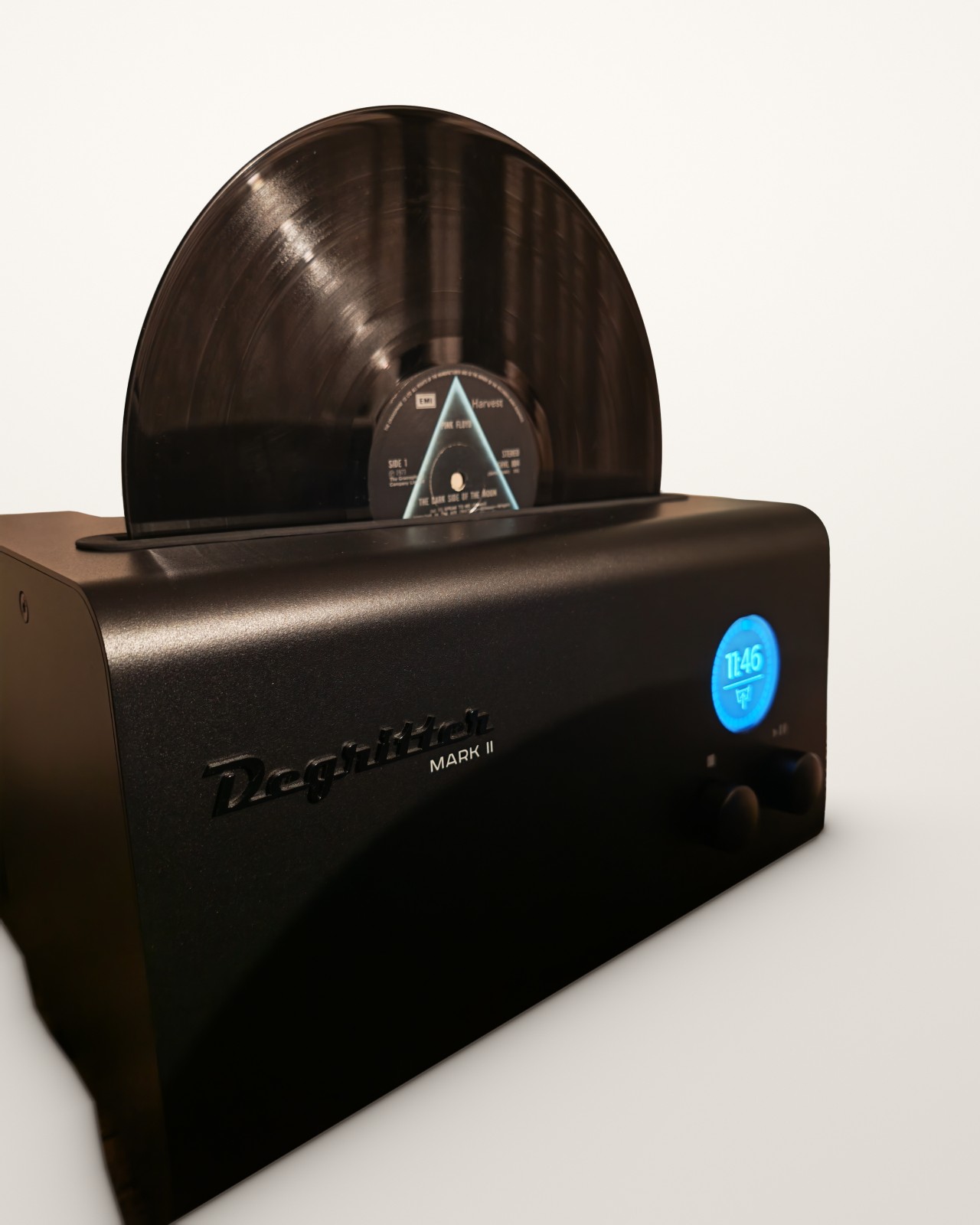
For now it's 12-inch LPs only (box sets are fine if every disc is 12-inch), with 7-inch and 10-inch coming soon. Prices start from £2.50 per disc, including a new anti-static inner sleeve, and there's a launch offer of 2 LPs for £6, one per customer, until 31 October 2026.
Buying from us? Every record bought from the website is still hand-cleaned before it goes out, and you can now add a Degritter clean at checkout for £2 per record.
Full prices, what we can and can't clean, and how to book are all on our record cleaning service page. Or have a dig through the crates, where every record is hand-graded and photographed as the actual copy before it goes to a good home.