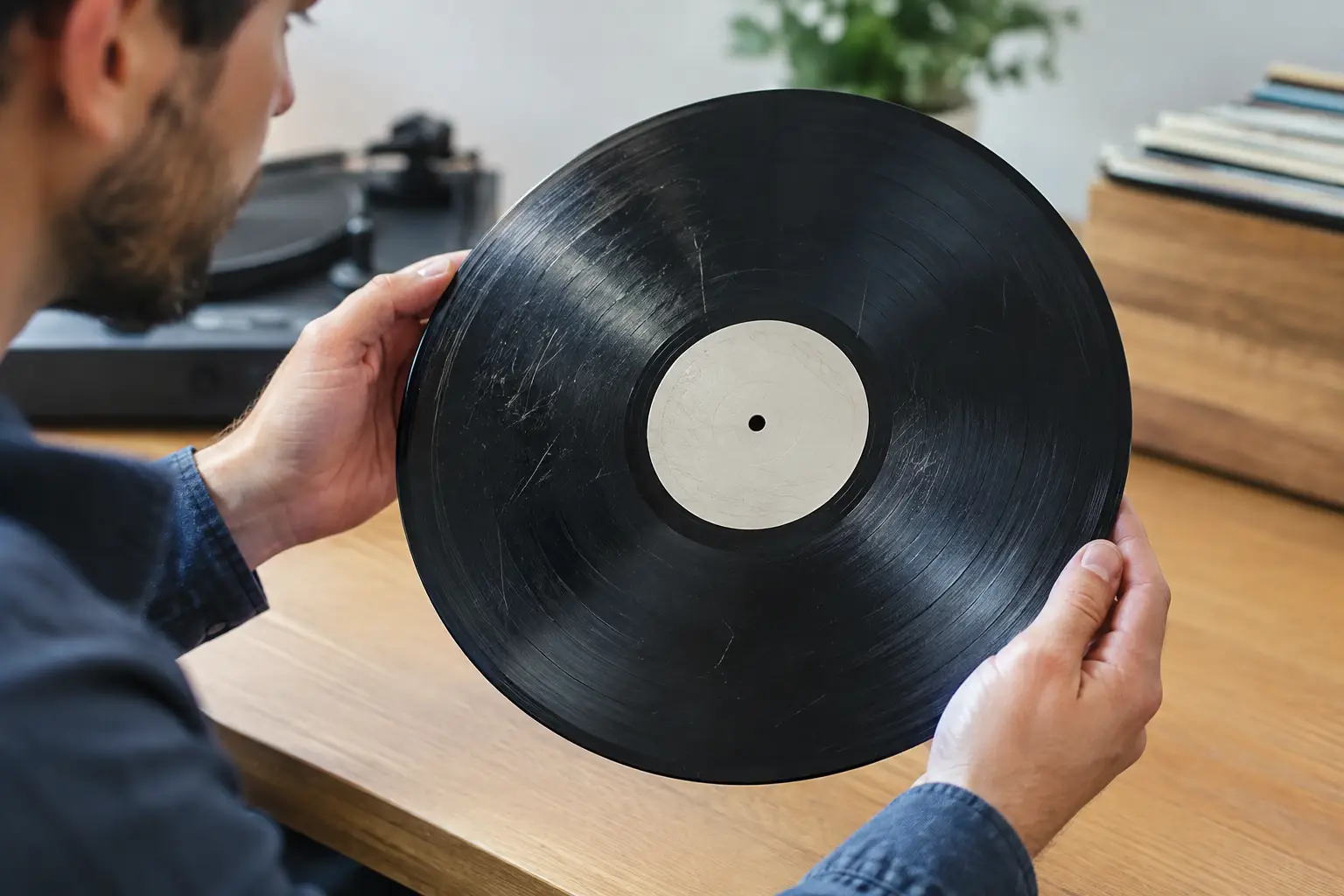
A record can look as though it has survived a pub floor, yet play far better than expected. Equally, one short-looking line across the grooves can produce a repeated click that spoils an otherwise lovely copy. So, are scratched records playable? Often, yes - but the answer depends on how deep the mark is, where it sits, and whether it has damaged the groove wall the stylus actually reads.
For collectors, this is why a condition grade should never be treated as decoration. A close visual inspection tells part of the story; careful playtesting tells you the rest. If you are buying a favourite Beatles LP, a first press Pink Floyd album or a hard-to-find Iron Maiden issue, the difference matters.
What a scratch does to a vinyl record
A vinyl record stores sound in microscopic groove walls. As the stylus travels through those grooves, it responds to the tiny changes cut into them. A superficial mark that merely sits on the surface may be audible only as a light tick, if at all. A deeper scratch can deform or cut across the groove, making the stylus jump, repeat, crackle loudly or skip ahead.
Not every visible line is a scratch. Sleeve scuffs, paper marks and residue can all catch the light and make a record appear rougher than it sounds. This is particularly common on darker vinyl under strong lighting. Conversely, a sharp mark that you can feel with a clean fingernail deserves caution, especially if it runs across rather than along the grooves.
The location matters as much as the appearance. Damage during a quiet acoustic introduction or between tracks can be more distracting than the same mark during a dense rock chorus. A single click in the run-in groove is one thing. Repeated noise across the opening of a favourite song is another.
Are scratched records playable? The practical answer
A scratched record remains playable when the stylus can track the damaged area without sticking, jumping or producing excessive noise. That does not necessarily mean it plays silently. Used vinyl is graded and valued on a spectrum, and many very enjoyable listening copies have occasional background crackle, light clicks or marks visible under direct light.
The key question is not simply, “Does it have a scratch?” It is, “What does the scratch do during playback?” A record with a couple of light, non-feelable surface marks may still play close to a Very Good Plus standard. A single deep feelable scratch can bring a copy down considerably, even when the rest of the disc looks clean.
There is also a difference between playability and collectability. A scarce catalogue number, original insert, unusual label variation or early pressing can retain serious collector appeal despite a noisy passage. But a buyer building a clean listening collection may reasonably prefer a less desirable edition in stronger playing condition. Neither approach is wrong, provided the condition is described clearly.
How to judge a mark before you buy
Photographs are useful, particularly close-ups taken in angled light, but they cannot fully predict playback. The most reassuring listing information explains both the visual condition and the audible result. Look for clear language about any feelable marks, recurring ticks, skips, distortion, groove wear and whether the record has been playtested.
A seller who says a record has “light surface marks” is describing appearance, not automatically sound. A better description adds practical detail: perhaps it plays with faint background noise between tracks, has several clicks on track two, or has been tested through without skips. Those details let you decide whether the copy suits your budget and expectations.
Be wary of broad claims such as “looks great for its age” where no grade or playback information is provided. Age alone does not define condition. A carefully stored 1970s LP can play beautifully; a more recent record mishandled with a worn stylus can have permanent groove damage.
At WholeLottaVinyl, the useful part of the process is not just spotting the mark but assessing it properly: records are cleaned, visually graded, photographed and playtested before listing. For online buyers, that level of handling removes much of the guesswork that a single front-and-back photo cannot solve.
Visual clues worth understanding
Some marks are less troubling than they first appear. Fine sleeve scuffs usually follow the direction of the grooves and can be caused by repeated removal from a paper inner. They may produce light background noise, but many do not interrupt playback. A cloudy film can be residue from an old sleeve or handling and may improve after an appropriate clean.
More concerning marks tend to be narrow, sharp and clearly defined. A line that crosses several grooves can create a series of clicks as the stylus encounters it. If it is deep enough, the same section may repeat. Greyish patches, especially in heavily played areas, can indicate groove wear rather than a scratch. Groove wear often presents as distortion or a fizzy quality on louder vocals and high frequencies, and cleaning cannot reverse it.
A record can also skip for reasons unrelated to a scratched groove. Dust lodged in the groove, static, an off-centre pressing, a damaged stylus or poor turntable setup may be responsible. That is why proper playtesting on a correctly set-up deck is more meaningful than dropping the needle on briefly and assuming all is well.
Can cleaning make scratches disappear?
Cleaning can remove dirt, fingerprints, residue and some of the noise caused by contamination. It cannot repair vinyl that has been physically cut, crushed or worn away. If a click is caused by a tiny piece of debris embedded in the groove, a careful clean may improve it dramatically. If the groove wall itself is damaged, the noise will remain.
Avoid the tempting home remedies often passed around by record addicts. Household polishes, abrasive cleaners and improvised fillers can leave residue, alter the surface or cause more harm than the original mark. A proper record-cleaning method, clean sleeves and sensible handling are far better long-term protection.
If you already own a marked record, give it a thorough clean before judging it. Then listen with a clean stylus on a turntable that is correctly balanced and aligned. Do not increase tracking force beyond the cartridge maker's recommended range in an attempt to force the stylus through a problem area. That can accelerate damage to both record and stylus.
When a scratch should affect your decision
A scratch is not an automatic reason to walk away. It should affect the price, the grade and your intended use. For a rare pressing that completes a long search, a handful of background ticks may be an easy compromise. For an album you want to play often and loudly, repeated clicks, distortion or a skip in a key track may quickly become frustrating.
Before committing, consider four practical points:
- Is the mark superficial, or can it be felt?
- Does the listing state what happens during playback?
- Is the noise limited to one brief section or spread across a side?
- Does the asking price fairly reflect the stated grade and rarity?
These questions keep condition in proportion. A visually imperfect record can be a superb listening copy, while a glossy-looking disc with groove wear can disappoint from the first chorus.
The grade should tell a truthful story
For secondhand vinyl, the best listings separate the condition of the disc from that of the sleeve and describe notable flaws rather than hiding behind a broad grade. A worn sleeve does not alter sound; a deep scratch certainly can. Likewise, an excellent-looking cover should not distract from a disc that has audible issues.
Collectors should expect sensible nuance. Very Good is not a bad grade, and it is not a promise of silence. It commonly means a record has been enjoyed, with visible signs of use and possible audible background noise, but remains a solid player. Very Good Plus generally indicates a cleaner experience with only minor signs of handling. Individual marks and playback notes still matter more than a grade alone.
The right scratched copy is the one whose condition, price and musical value line up with your expectations. Ask for honest playback detail, use the photographs alongside the description, and leave room in your collecting for records that have lived a little - provided they can still let the music through.